Purcellville, Virginia History
Purcellville web site
Nichols Hardware Store »
Purcellville's Orchard Grass Seed Mill »
How Purcellville became a town »
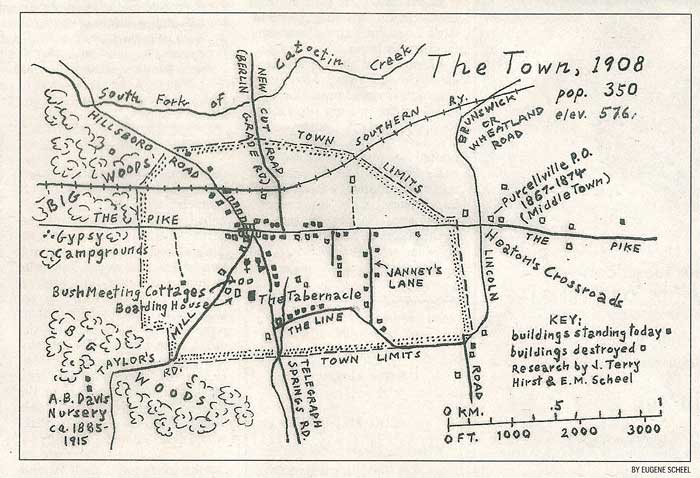
1908 map of Purcellville, VA
Although the first land grant in the area was issued by Lord Fairfax in 1740 it was not until 1764 that Purcellville's first known settler, James Dillon from Buck's County, Pennsylvania, arrived.1 As might be expected, it would take a road to make a town; the early ox cart track which wound westward from Leesburg, known later as the "Great Road," serve the purpose. The first recorded business, an ordinary (a combined store and inn), was established by Abraham Vickers in 1799. This was followed by a second ordinary, established by Stacey Taylor in 1804, and later by "Purcel's Store" and Post Office, Established by Valentine Vernon Purcell (from whom the Town's name is derived). A blacksmith's shop, established around 1848, was also among the Town's earliest businesses. The Town's first public school was built in 1883. On July 9, 1853 the village officially adopted the name Purcellville and on March 14, 1908 the Town was incorporated by an act of the General Assembly.
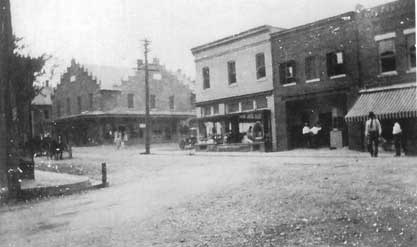
Purcellville's Main Street in early 1900s. The right center building is now the White Palace Restaurant. It was originally Hampton Hall.
The Great Road became an authorized turnpike in 1785 and extended the turnpike system westward from Alexandria to Snicker's Gap, and beyond to Berryville and Winchester.2 With the construction of this Turnpike in 1832, travel through Purcellville began to increase--the first stagecoach arrived in 1841. A railroad link was built to Leesburg prior to the Civil War, and travel to points further west were continued by stagecoach through Purcellville. When the railroad was extended to Purcellville in 1874, The Town took Leesburg's place as the beginning of the stage route until the railroad was extended to Round Hill in 1875. (This railroad ceases operation in 1968.)
Although there were several marches and chases through Purcellville during the Civil War, the town sustained no major damage. However, a series of disastrous fires, the first in 1900 and then two more in 1914, virtually wiped out the business district, depriving the Town of much of its earliest architectural heritage. Despite the fires, many of the old blocks have been rebuilt and the business district has been extended considerably.
From its very beginning, the Town's dependence upon transportation links to the more populous eastern sections of Northern Virginia has remained strong, and is now more important than ever. Since the Virginia Department of Transportation has widened Route 7 and extended the Toll Road to western Loudoun County, all within the past five years, Purcellville's moderate growth during this period should not be seen as indicative of its future growth. Furthermore, Purcellville's traditional dependence upon agriculture as its primary source of income has diminished as more and more residents are employed outside of the community. The challenge is to accept this change without the Town losing its historic identity and those everyday, small town amenities which have developed over its long history.
1 Town history is summarized from The Story of Purcellville by Eugene M. Scheel, reprinted in Commemoration of its 75th anniversary 1908-1983.
2 Historic Roads of Virginia, Nathaniel Mason Pawlett, Virginia Highway Research Council, 1977.