Loudoun County's Beginning
Taken from the book by James W. Head, History and Comprehensive Description of Loudoun County, Virginia, published by Park View Press in 1908.
See also The Project Gutenberg EBook of Legends of Loudoun , by Harrison Williams, 1938
In 1742, Prince William County, a part of the stupendous Culpeper grant, was divided and the county of Fairfax created and named in honor of its titled proprietor. Commencing at the confluence of the Potomac and Occaquan rivers, the line of demarcation followed the latter stream and its tributary, Bull Run, to its ultimate source in the mountain of that name, from which point it was continued to the summit of said mountain, pursuing thereafter a direct course to the thoroughfare in the Blue Ridge, known as "Ashby's Gap."
In 1757, Fairfax was divided and the territory west of its altered boundary christened "Loudoun County." The new line followed the stream called Difficult Run, from its junction with the Potomac to its highest spring-head, and from that point was continued in a direct line to the northeast border of Prince William County. This boundary was afterwards changed and the present line between Loudoun and Fairfax substituted (see "Boundaries," page 17).
The following are excerpts from the proceedings of the Virginia House of Burgesses that led to the creation of Loudoun County in May, 1757. The act authorizing the division of Fairfax and establishment of Loudoun is given intact:
On April 20, 1757 a "petition of sundry inhabitants of Fairfax County, praying a Division of the said County, was presented to the House and read, and referred to the Consideration of the next Session of Assembly." On Friday, April 22, 1757, "Mr. Charles Carter, from the Committee on Propositions and Grievances, reported, that the Committee had had under their consideration divers Propositions, from several Counties to them referred, and had come to several Resolutions thereupon, which he read in in Place, and then delivered in at the Table, where the same were again twice read, and agreed to by the House, as follow:"
"Resolved, That the Petition of sundry Back-Inhahitants of the said County of Fairfax, praying the same may be divided into two distinct Counties, by a Line from the Mouth u~i the main Branch of Difficult to the Head thereof, and thence by a straight Line to the Month of Rocky-Run, is reasonable."
The following Monday the bill was again presented to House by Charles Carter, of the Committee of Propositions and Grievances, and Friday, April 29, 1757, was order engrossed and read a third time-Monday, May 2, 1757, the engrossed Bill, entitled, "An Act for dividing the county of Fairfax," was read a third time, passed by the House, and sent to the Council for their "concurrence." It received the assent of the governor Wednesday, June 8, 1757.
An Act for Dividing the County of Fairfax.
(Passed May 2, 1757.)
I. WHEREAS, Many inconveniences attend the upper inhabitants the county of Fairfax, by reason of the large extent of the said county and their remote situation from the court-house, and the said inhabitants have petitioned this present general assembly that the said county may be divided: Be it, therefore, enacted, by the Lieutenant-Govenor, Council, and Burgesses of this present General Assembly, and it is hereby enacted, by the authority of the same, That from and after the 1st day of July next ensuing the said county of Fairfax be divided into two counties, that is to say: All that part thereof, lying above Difficult run, which falls into patowmack river, and by a line to be run from the head of the same run, a straight course, to the mouth of Rocky run, shall be one distinct county, and called and known by the name of Loudoun: And all that part thereof below the said run and course, shall be one other distinct county, and retain the name of Fairfax.
II. And for the due administration of justice in the said county of Loudoun, after the same shall take place: Be it further enacted by the authority aforesaid, That after the first day of July a court for the said county of Loudoun be constantly held by the justices thereof, upon the second Tuesday in every month, in such manner as by the laws of this colony is provided, and shall be by their commission directed.
III. Provided always, That nothing herein contained shall be constructed to hinder the sheriff or collector of the said county of Fairfax, as the same now stands entire and undivided, from collecting and making distress for any public dues, or officers fees, which shall remain unpaid by the inhabitants of the said county of Loudoun at the time of its taking place; but such sheriff or collector shall have the same power to collect or distrain for such dues and fees, and shall be answerable for them in the same manner as if this act had never been made, any law, usage, or custom to the contrary thereof in any wise notwithstanding.
IV. And be it further enacted, by the authority aforesaid, That the court of the said county of Fairfax shall have jurisdiction of all actions and muts, both in law and equity, which shall be depending before them at the time the said division shall take place; and shall and may try and determine all such actions and suits, and issue process and award execution in any such action or suit in the same manner as if this act had never been made, any law, usage, or custom to the contrary in any wise notwithstanding.
V. And be it further enacted, by the authority aforesaid, That out of every hundred pounds of tobacco, paid in discharge of quit rents, secretary's, clerk's, sheriff's, surveyor's, or other officers fees, and so proportionally for a greater or lesser quantity, there shall be made the following abatements or allowances to the payee; that is to say: For tobacco due in the county of Fairfax ten pounds of tobacco, and for tobacco due in the county of Loudoun twenty pounds of tobacco; and that so much of the act of the assembly, instituted, An Act for amending the Staple of Tobacco, and preventing frauds in his Majesty's customs, as relates to anything within the purview of this act, shall be, and is hereby repealed and made void.
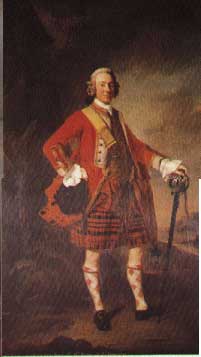
Lord Loudoun
Derivation of Name
Loudoun County was named in honor of Lord Loudoun, a representative peer of Scotland, who, the year before its establishment, and during the French and Indian war, had been appointed captain-general and governor-in-chief of the province of Virginia, and commander-in-chief of the British military forces in the Colonies. More on Lord Loudoun »
His military avocations, however, prevented him from entering upon the duties of the gubernatorial office, and it is believed that he never visited the colony of Virginia. Dinwiddie continued in the control of its affairs, while Loudoun turned his attention to military matters, in which his indolence, indecision, and general inefficiency were most conspicuous and disastrous. Franklin said of him: "He is like little St. George on the sign-boards; always on horseback, never goes forward."
Until his early recall to England, contemporaneous writers and brother officers mercilessly criticized Loudoun"whom a child might outwit, or terrify with a pop-gun."
Hardesty's Historical and Geographical Encyclopedia contains the following succinct account of the public services rendered by this noted Scotchman:
"John Campbell, son of Hugh, Sari of Loudoun, was born in and succeeded his father in the title in November, 1731. In July, he arrived in New York with the appointment of governor-in-chief Virginia, and also with the commission of commander-in-chief of British forces in America, but, proving inefficient, returned to England in 1757. He was made Lieutenant-General in 1758, and General in 1770. He died April 27,1782, and was succeeded by Norborne Berkeley, Baron de Botetourt, as governor of Virginia, in 1768."
Settlement and Personnel
The permanent settlement of Loudoun began between years 1725 and 1730 while the County was yet a part of Prince William and the property of Lord Fairfax, the immigrants securing ninety-nine-year leases on the land at the rate of two shillings sterling per 100 acres. The above-noted interim saw a steady influx of the fine old English Cavalier18 stock the settlers occupying large tracts of land in the eastern and southern portions of the County or most of the territory extending from the Potomac River southward to Middleburg and from the Catoctin and Bull Run mountains eastward the eastern border of the County. It is more to this noble chivalric strain than to any other that Loudoun owes her present unrivalled social eminence.
John Esten Cooke's faithful and eloquent delineation of Virginia character is peculiarly applicable to this Cavalier element of Loudoun society. Some conception of that author's grandiose style and intimate knowledge of his subject may be gained from the following passage:
"The Virginian of the present time has ingrained in his character the cordial instincts and spirit of courtesy and hospitality which marked his ancestors. He has the English preference for the life of the country to the life of the city; is more at home among green fields and rural scenes than in streets; loves horses and dogs, breeds of cattle, the sport of fox-hunting, wood-fires, Christmas festivities, the society of old neighbors, political discussions, traditions of this or that local celebrity, and to entertain everybody to the extent of, and even beyond, his limited means. Many of these proclivities hare been lang lied at, and the people have been criticized as provincial and narrow-minded; but after all it is good to love one's native soil, and to cherish the home traditions which give character to a race. Of the Virginians it may be said that they have objected in all times to being rubbed down to a uniformity with all the rest of the world, and that they have generally retained the traits which characterized their ancestors."
The northwestern part of the County, known as the "German Settlement," a section of about 425 square miles, extending from Catoctin Mountain westward to the Short Hill Mountains and from the Potomac River southward to near Wheatland, was originally settled by a sturdy and vigorous race of Germans,19 principally from Pennsylvania, but a few from New York, in which two colonies they had settled on their arrival, only a few years before, from the Palatine states of Germany. They came to Loudoun between the years 1730 and 1735,20 about the time of the Cavalier settlements.
These German settlers were a patient, God-fearing people, naturally rugged, and very tenacious in the preservation of their language, religion, customs and habits. Every stage in their development has been marked by a peaceable and orderly deportment-a perfect submission to the restraints of civil authority.
The earliest of these German arrivals, with native foresight and a proper appreciation of the dangers incident to border settlement in that day of bloody Indian atrocities, came to Loudoun in an organized body, embracing sixty or more families.
Many of the males were artisans of no mean ability, and plied their respective trades as conscientiously and assiduously as others, in the rude manner of the times, tilled their newly acquired acres.
In this way, a congenial, stable, and self-sustaining colony, founded on considerations of common safety and economic expediency, wag established amongst these storied hills of frontier Virginia.
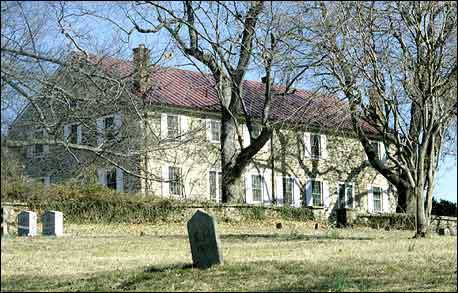
Fairfax Meeting House in Waterford Virginia. Built in 1761 and 1771, it sits on the site of the original 1741 structure.
Almost simultaneously with these settlements came other emigrants from Pennsylvania and the then neighboring colonies, among them many members of the Society of Friends Quakers.21 Not a few of this faith came direct from England and Ireland, attracted by the genial climate, fertile soils at bountiful harvests, accounts of which had early gained spread circulation. They chose homes in the central portion of the County, southwest of Waterford and west of Leesburg that section being generally known as the "Quaker Settlement."
Each summer brought them new accessions of prosperity and devout brethren to swell their numbers; and soon they had caused the wilderness to blossom as the rose. Here they found freedom of religious and moral thought, a temperate climate, and the wholesome society of earnest compatriots.
Then, as now, a plain, serious people, they have left the impress of their character-thrifty, industrious, and conspicuously honest-upon the whole of the surrounding district.
No concerted violence, it is believed, was offered these settlers by the Indians who seem to have accredited them with the same qualities of honesty, virtue, and benevolence, by the exercise of which William Penn, the founder of the faith in Pennsylvania, had won their lasting confidence and esteem.
The Quaker is a type with which all the world is familiar and needs no particular portrayal in this work. The Quakers of Loudoun have at all times remained faithful adherents of the creed, their peculiar character, manners, and tenets differing to no considerable extent from those of other like colonies, wherever implanted.
It is doubtful if any race has done more to stimulate and direct real progress, and to develop the vast resources of Loudoun, than that portion of our earlier population known as the Scotch-Irish. Their remarkable energy, thrift, staidness, and fixed religious views made their settlements the centers of civilization and improvement in Colonial times; that their descendants proved sturdy props of the great cause that culminated in the independence of the United States is a matter of history.
Notes
18. This stock was the first to introduce and foster slavery in the County. Goodhart's History of the Loudoun Rangers.
19. The first sheep were brought to the County by these settlers. Goodhart's History of the Loudoun Rangers.
20. 1732 was most likely the year in which the earliest of these German settlers arrived in Loudoun.
21. The term Quaker, originally given in reproach, has been so often used, by friend as well as foe, that it is no longer a term of derision, but is the generally accepted designation of a member of the Society Friends. Goodhart's History of the Loudoun Rangers.